August 17, 2026


In any MR16 vs GU10 spotlight debate, one thing is clear: these versatile fixtures are the unsung heroes of interior design. They are great for casting a warm glow over a kitchen island, illuminating a dynamic hallway art gallery, or highlighting functional workspaces. These compact light sources can shape the architectural feel of your rooms.
So, if you’re upgrading your fixtures or moving to energy-efficient smart LED technology, let’s break down the main differences to help you choose between GU10 vs MR16 spotlight bulbs.
While these two bulbs look remarkably similar, their internal electronics, base fittings, and power configurations are entirely different. Installing the wrong bulb can cause electrical mismatches or physical installation issues. Understanding the unique mechanics of each bulb type makes it easy to find the perfect smart lighting fit for your home's layout.

The technical breakdown of GU10 and MR16 bulbs
To find the right bulb, you must look at how each operates and connects to your home's electrical grid. Though both share a standard 2-inch (50 mm) face diameter, they rely on different technologies to produce light.
Voltage
High Voltage (220–240V / 110–130V)
Low Voltage (12V AC/DC)
Base Connection
GU10 (Twist-and-lock)
GU5.3 (Push-fit bi-pin)
Power Source
Direct mains power
Requires external 12V transformer/driver
Lumens (Brightness)
Typical: 350 – 500 lm (LED) (Up to 600+ lm for high-output models)
Typical: 350 – 500 lm (LED) (Transformer stability can affect actual output)
Beam Angle Options
Narrow spot (24° – 36°) to wide flood (60° – 110°)
Narrow spot (15° – 36°) to wide flood (60°)
Color Rendering Index (CRI)
Standard: 80+ CRI High-end: 90–97+ CRI
Standard: 80+ CRI High-end: 90–98+ CRI (Popular in galleries for accurate color)
Wattage Equivalency
4.5W–6W LED ≈ 50W Halogen
5W–7W LED ≈ 35W–50W Halogen
Best Suited For
Simple retrofits, mains-powered downlights
Precise spot lighting, damp zones (bathrooms), legacy 12V systems
Is MR16 the same as GU10?
Despite sharing a very similar front glass appearance, MR16 and GU10 are not the same. MR16 refers to a bulb shape that runs on low-voltage 12V power and uses a GU5.3 bi-pin push-in base. GU10 refers to a mains-voltage bulb that plugs directly into line power using a twist-and-lock mechanism. They operate on entirely different voltages and are not directly interchangeable without modifying your fixture hardware.
Sockets, pins, and physical connections
The easiest way to tell these spotlights apart is to examine their base connection pins. While people often wonder are MR16 and GU10 the same size, the truth is that while both typically share a standard 50 mm (2-inch) outer reflector diameter, their bases, pins, and overall profile are quite distinct:
GU10 Bulbs: A GU10 bulb features two thick, blunt pins with tiny "feet" at the ends, spaced exactly 10 mm apart. These bulbs use a push-and-twist mechanism to lock securely into the light socket.
MR16 Bulbs: The classic MR16 spotlight bulb features a GU5.3 base with two thin, sharp needle-like pins spaced 5.3 mm apart. These bulbs simply push straight into the socket without twisting.
Check our guide to choosing the right bulb size.
Line voltage vs. low voltage
The fundamental operating difference lies in how they handle electricity:
GU10 bulbs run on-line voltage, which is the standard mains electricity running through your home's walls (typically 120V in the US). This means they connect directly to your light switch circuits without needing extra equipment.
MR16 bulbs operate on low-voltage 12V electricity. Because standard household outlets supply much higher voltage, MR16 systems require a specialized 12 volt MR16 transformer to step down the power before it reaches the bulb.
Choosing between GU10 and MR16 setups
Determining which system to use depends on whether you are retrofitting existing fixtures or designing a new home layout from scratch.
If you are upgrading an existing spotlight, remove one of your current bulbs to check its base pins. If you find thin needle pins and a hidden transformer box in your ceiling cavity, your system is built for MR16 spotlights.

If you have a twist-and-lock socket, it is a GU10 setup.

Can You Change MR16 to GU10?
Yes, you can convert an MR16 system to GU10, but it requires more than just popping in a new bulb. Because MR16 systems run through an external 12V transformer and use GU5.3 sockets, transitioning to mains-voltage GU10 requires removing or bypassing the transformer altogether.
An electrician will need to disconnect the 12V transformer, wire household mains electricity directly to a new GU10 lamp holder socket, and swap the internal fixture casing if housing depths differ. Converting to GU10 simplifies long-term maintenance by removing transformer failure points, though many homeowners prefer keeping their MR16 setup and opting for direct-fit 12V smart LEDs to avoid rewiring completely.
Designing a New Setup
If you are building or remodeling, GU10 is highly popular due to its simplicity. It eliminates the need to buy, hide, and maintain separate electronic transformers, streamlining your hardware setup from day one.
However, low-voltage 12V MR16 setups remain highly valued in areas where electrical safety is paramount. Because lower voltages are far safer around moisture, MR16 fixtures are frequently favored in bathroom zones, outdoor landscape paths, and subtle garden spotlighting.
Recommended Philips Hue spotlight products
Use this guide to find the perfect smart spotlight bulb for your home fixtures:
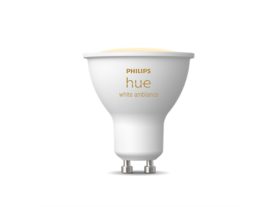
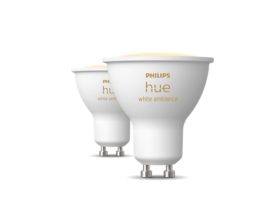
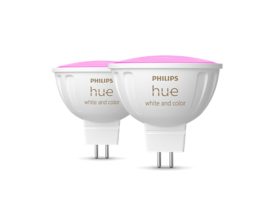
Discover the Hue LED bulbs collection.
Retrofitting with Philips Hue smart LED spotlights
Upgrading to smart, energy-efficient lighting does not require a complete ceiling rewiring. If you want to transition away from hot, power-hungry old halogen bulbs, Philips Hue offers options for both systems.
Replacing conventional halogen spotlights with modern smart LEDs delivers dramatic reductions in power consumption and operating costs. Traditional GU10 and MR16 halogen bulbs typically consume 35W to 50W of electricity per bulb. In contrast, equivalent smart LED spotlights like the Philips Hue GU10 or MR16 consume only 4.5W to 6.5W to produce identical or superior brightness (around 400–430 lumens).
This translates to roughly 85% to 90% energy savings on your lighting power draw. Because LEDs run significantly cooler and last up to 25,000 hours, retrofitting your home leads to immediate utility savings and significantly reduced long-term maintenance.
Energy savings: Smart LED vs traditional halogen bulbs
Power Consumption (Wattage)
35W – 50W
4.5W – 6.5W
Brightness Output
~400 – 430 lumens
~400 – 430 lumens
Energy Efficiency Savings
Baseline reference
85% – 90% reduction in power draw
Heat Output
High (wastes significant energy as thermal heat)
Extremely low (runs significantly cooler)
Average Lifespan
1,000 – 2,000 hours
Up to 25,000 hours
Maintenance & Replacement
Frequent replacements needed
Long-term durability with reduced maintenance
For standard twist-and-lock fixtures, swapping your old bulbs with a smart GU10 MR16 led bulb alternative like the Philips Hue GU10 range takes only seconds. These bulbs connect directly to your home's electrical line and unlock millions of colors and tunable white options.
If your home utilizes low-voltage tracks or recessed ceiling cans, you can integrate the Philips Hue MR16 smart spotlight. These are designed to be highly compatible with existing magnetic and electronic transformer setups, allowing you to install smart color lighting directly into your existing 12 volt MR16 transformer infrastructure.
Once installed, your new spotlights can be grouped using the Philips Hue app to build beautiful daily routines, set warm morning wake-up sequences, or create immersive entertainment areas.
To expand your home lighting layout, browse our comprehensive guides on living room lighting ideas or discover how to use accent lighting to add dramatic depth and contrast to your living space.
Smart accessories to manage your home spotlights
Ensure complete, effortless control over your newly installed smart spotlights with these dedicated accessories and controllers:
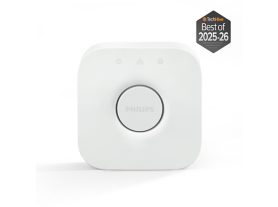
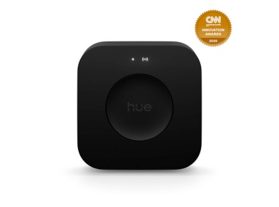
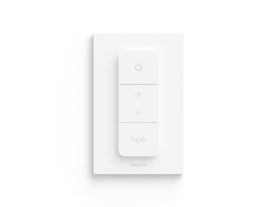
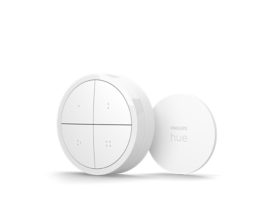
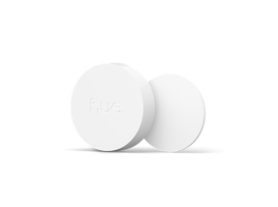
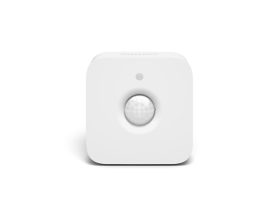
Explore the Hue smart lighting controls.