How long do LED bulbs last?
LED lighting revolutionized how long do LED bulbs last, and smart bulbs like Philips Hue combine that endurance with advanced control. But exactly how long can you expect a Hue bulb to function reliably? That depends on a mix of rated specifications, usage patterns, and environmental factors.
How long do LED bulbs last in general?
Before diving into Hue specifics, it's useful to understand LED lifespan in general:
- High-quality LED bulbs (non-smart) are often rated between 25,000 and 50,000 hours.
- That means even a bulb used 8 hours a day could last 8–17+ years.
- However, those ratings apply to the LED chips themselves, under ideal conditions (stable temperature, adequate cooling, correct electrical supply).
- Other components (power drivers, circuit boards, capacitors) may degrade earlier, which is why real-world lifespans often vary.
- Frequent power cycling (turning on/off), overheating, voltage spikes, or enclosed fixtures that trap heat can reduce lifespan.
Expected lifespan for Hue smart bulbs (Generic)
Now, specifically for Philips Hue:
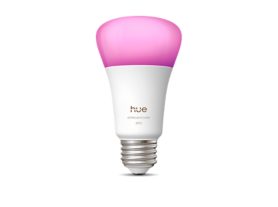
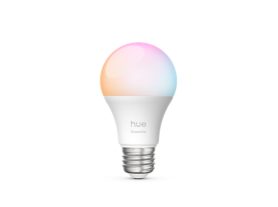
- For second- and third-generation Hue bulbs (White, White Ambiance, and White & Color Ambiance), a common rating is 25,000 hours.
- Some sources also mention 50,000 on/off cycles as a rating alongside hour estimates.
- Older or specialty Hue bulbs (e.g. filament style) often have lower ratings, such as 15,000 hours.
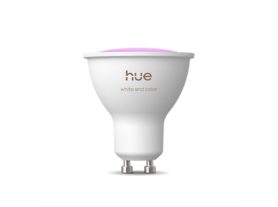
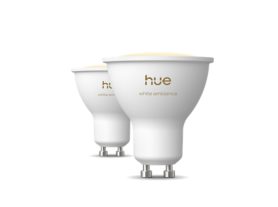
- For example, new GU10 Hue spotlights are explicitly noted to have improved lifetime (25,000 hours) over older variants.
Explore the advantages of LED lights.
If you use a Hue bulb 8 hours per day, 365 days a year:
- 25,000÷8=3,12525{,}000 \div 8 = 3{,}12525,000÷8=3,125 days ≈ 8.6 years
- If usage is lower, say 4 hours per day, then 25,000÷4=6,25025{,}000 \div 4 = 6{,}25025,000÷4=6,250 days ≈ 17+ years
- Some community users report their Hue bulbs still working after 5, 8, or even 10+ years.
Considering the average lifespan of LED bulbs, most households will only need to replace a Hue bulb once or twice over the lifetime of their smart lighting setup.
What factors affect actual lifespan?
Even though specification sheets are useful, real usage and environment matter significantly:
Heat & ventilation
Smart bulbs generate a small amount of heat; insufficient cooling (e.g. sealed fixtures) can cause components to degrade faster.
Power quality & surges
Voltage spikes or inconsistent power can degrade internal circuits. Using surge protectors or stable power lines is beneficial.
Power cycling (On/Off)
Frequent switching can stress components or solder joints. Hue ratings that include cycles (e.g. 50,000 cycles) account for this factor.
Electronics & driver aging
Even if the LED diode is fine, the driver or internal capacitor might fail earlier. This is a known weak point in many LED systems.
Usage patterns
Higher intensity (full brightness) and more hours per day reduce available headroom. If you dim or use automation, that spreads wear.
Check LED bulbs types
Longevity in real use — What users report
Beyond specs, real-world users offer valuable insight:
- Some Reddit users report Hue bulbs still working after 4–5 years with heavy daily use.
- Others observe that color bulbs sometimes dim or shift color before full failure.
- Reports exist of older Gen 1 bulbs (rated 15,000 hours) still functioning beyond their spec in favorable conditions.
- Some users caution that “standby current,” when bulbs are connected but off, isn't usually considered in test ratings.
- It’s natural to question, do LED lights get dimmer over time—and the answer is yes, though the decline in brightness happens very gradually throughout the bulb’s life.
These anecdotes align with the expectations: specs are benchmarks, not guarantees.
Philips Hue-specific considerations
When applying these principles to Hue products, consider:
- Warranty vs. rated hours: Hue typically offers a 2–3 year warranty, depending on the model or region. So actual bulb replacement is unlikely unless there’s a defect. (Check your local warranty terms.)
- Consistency across variants: Hue maintains the same rating across many of its color, white ambiance, and white only models—so you don’t lose lifespan by choosing color.
- Upgrades (GU10, filament, etc.): Newer models like GU10 are receiving explicit lifetime upgrades (still 25,000 hours for current models) compared to older versions.
- Smart functions won’t shorten lifespan (much): The smart features (Zigbee, Bluetooth, connectivity) draw minimal power compared to the LED light itself; they’re designed to operate for the expected life.
- Using dimming and automation helps: Automatically reducing brightness or scheduling off times can help extend useful life by lowering stress on the LED.
Summary
Hue LED light bulbs are designed for long-term performance, with most standard models rated for around 25,000 hours of use. So, how long do LED bulbs last in real-world conditions? That translates to roughly 8–17+ years, depending on brightness settings, usage habits, and environmental conditions. Many Hue users even report their bulbs still working flawlessly after 5 to 8 years of regular use. If you own Philips Hue bulbs, you’re unlikely to replace them frequently—especially when your setup includes automation, dimming, and temperature control. The LED core is robust, and as long as your driver and electronics remain healthy, your smart lighting can serve reliably for well over a decade.